On January 14, 2026, the World Meteorological Organization (WMO) confirmed that 2025 was among the three warmest years on record, extending a streak of exceptionally high global temperatures.
One of the pillars of the this authoritative analysis is the China-MST 3.0 dataset, a global surface temperature benchmark independently developed by a research team from Sun Yat-sen University (SYSU).
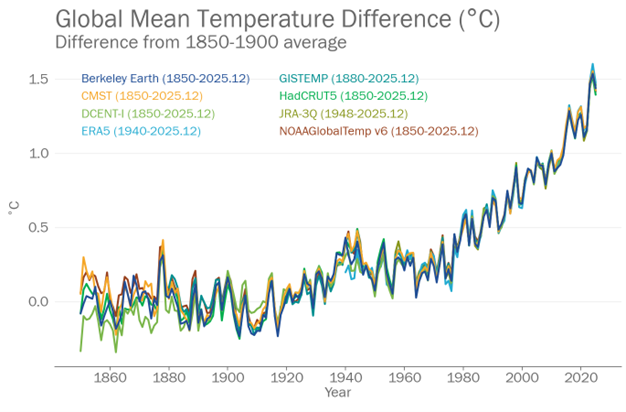
The China-MST (CMST) dataset, developed by Sun Yat-sen University, is among the key global benchmarks used in the latest WMO climate assessment.
Led by Professor Qingxiang Li from SYSU's School of Atmospheric Sciences, the China-MST 3.0 dataset represents a significant leap in climate data precision. The dataset integrates the team's proprietary global land surface temperature data with top-tier international marine temperature records.
To provide a truly comprehensive global perspective, the team utilized innovative scientific reconstruction techniques to fill critical data gaps in "data-sparse" regions, such as high-altitude plateaus and the polar regions. By systematically evaluating and minimizing uncertainties, the team has substantially enhanced the spatial and temporal integrity of global temperature sequences. Today, China-MST 3.0 stands as a vital international benchmark for monitoring and assessing the Earth's shifting climate.
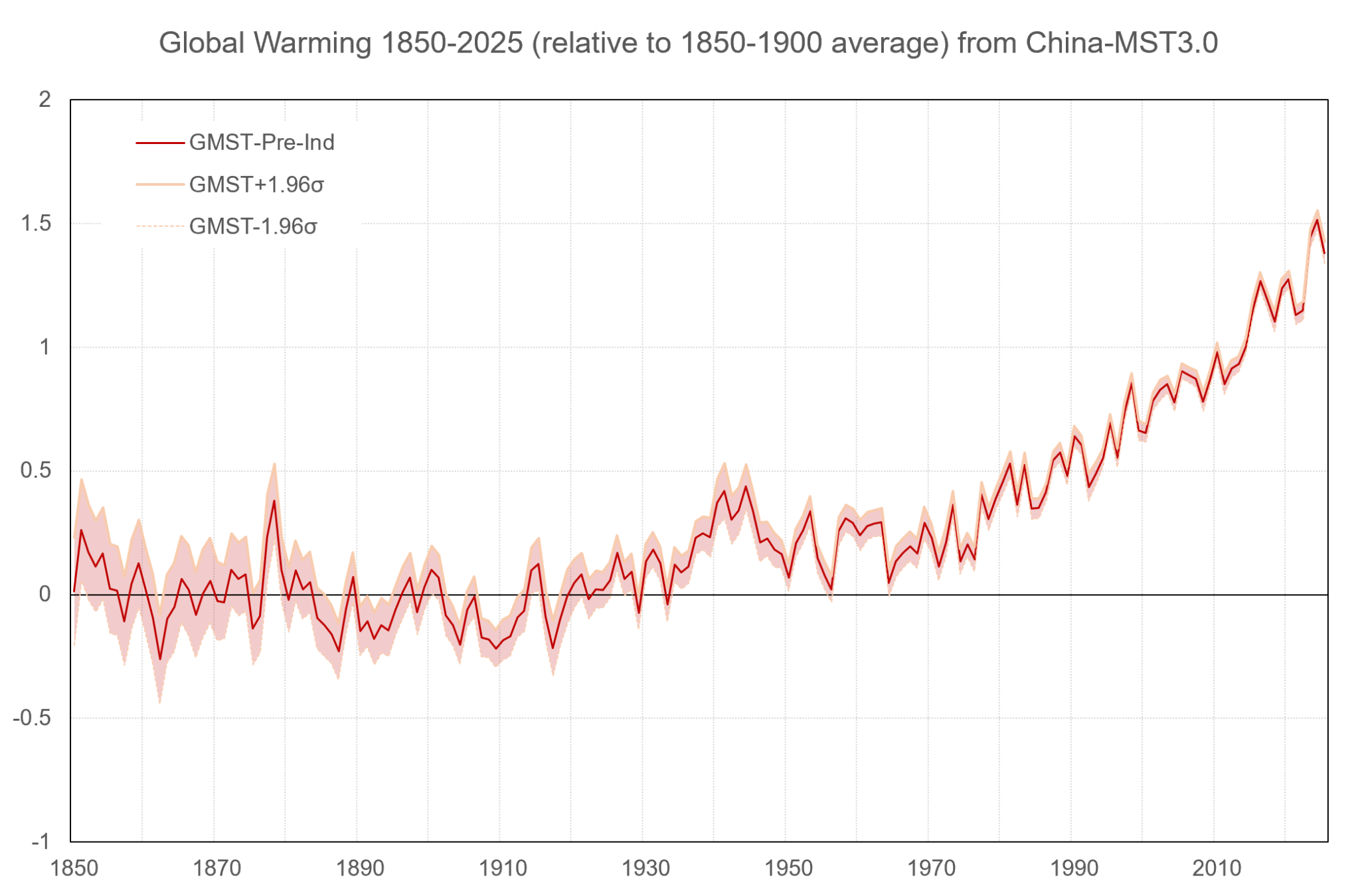
The 1850–2025 global surface temperature sequence, derived from the China-MST 3.0 dataset.
Evaluation based on the China-MST 3.0 dataset shows that the global mean surface temperature in 2025 rose by 1.07°C ± 0.05°C compared to the 1961-1990 climate baseline, representing a 1.39°C ± 0.13°C increase relative to pre-industrial levels. These findings rank 2025 as the third warmest year in 176 years of systematic records, trailing only 2023 and 2024. Furthermore, the report emphasizes the persistence of global warming, noting that the last twelve years from 2014 to 2025 all rank among the twelve warmest years in history.
This marks the second time the team's data has been adopted by a major international climate authority, following its inclusion in the Intergovernmental Panel on Climate Change (IPCC) Sixth Assessment Report (AR6) in 2021. The WMO's endorsement of China-MST 3.0 highlights the growing role and influence of Chinese climate science in global research and policy discussions.
Looking forward, the SYSU research team plans to further deepen foundational data research and expand international collaboration. Their goal is to refine domestic datasets to meet higher climate-quality benchmarks, thereby delivering a more robust scientific foundation for global and regional climate action.





 COPYRIGHT©1999-2017 , SUN YAT-SEN UNIVERSITY