A collaborative study led by Sun Yat-sen University (SYSU) has systematically identified a critical "advantageous" mutation in the Ebola virus (EBOV) that emerged during the devastating 2018–2020 epidemic. The findings, published on January 23 in the prestigious journal Cell, offer vital scientific clues for understanding viral evolution and developing broad-spectrum antiviral strategies.
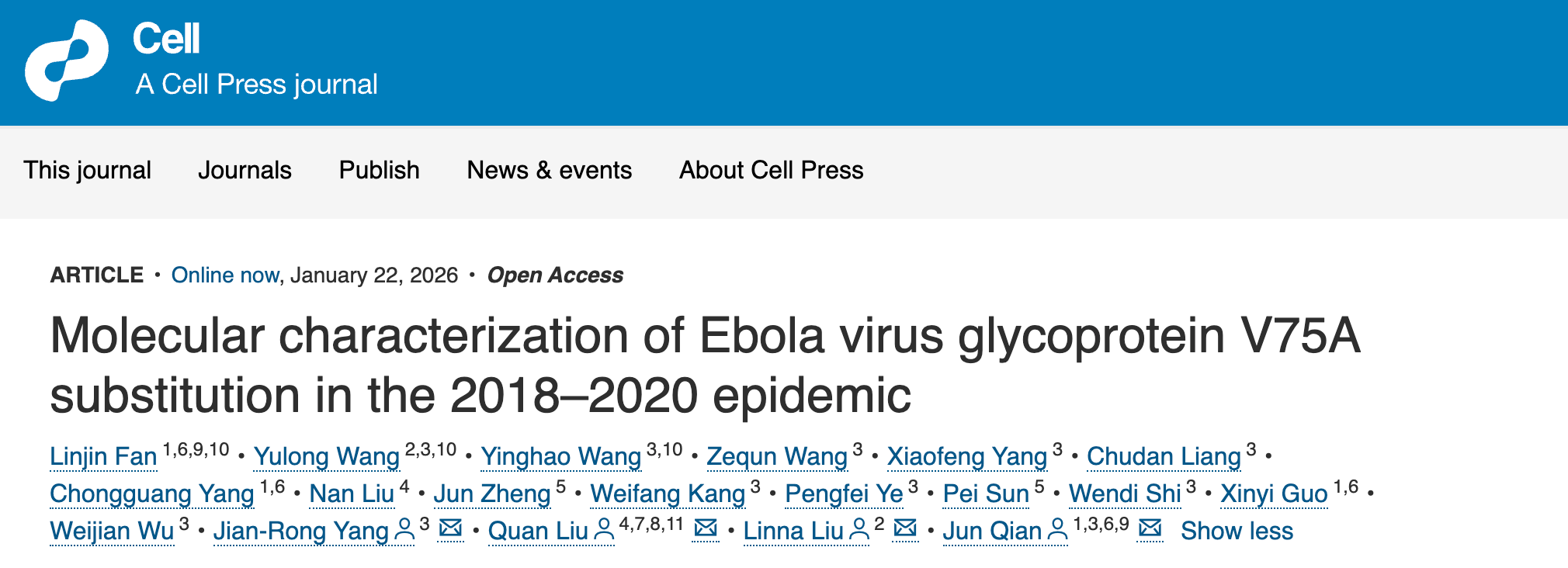
The study was spearheaded by Professor Jun Qian from the School of Public Health (Shenzhen) at SYSU, in collaboration with teams led by Professor Linna Liu from Guangzhou Eighth People's Hospital, Guangzhou Medical University, Professor Quan Liu from the First Hospital of Jilin University, and Professor Jianrong Yang from SYSU’s Zhongshan School of Medicine.
Unmasking a "Cunning" Virus
Ebola virus disease is a highly lethal infectious disease posing severe threats to global public health, yet specific treatments remain limited. The 2018–2020 outbreak in the Democratic Republic of the Congo (DRC) was the second largest in history, resulting in approximately 3,400 cases and 2,200 deaths.
While limited local medical infrastructure contributed to the outbreak's severity, the research team sought to answer a critical biological question: Did the virus itself mutate to become more elusive and infectious?
"In major epidemics, key viral mutations are often the invisible drivers of accelerated transmission," said Professor Jun Qian. "Having engaged with Ebola for over a decade, we felt compelled to determine if EBOV follows a similar evolutionary pattern."
The Discovery of GP-V75A
By analyzing 480 whole-genome sequences of EBOV, the team found that a mutation in the glycoprotein, GP-V75A, emerged early in the epidemic. This mutant strain rapidly replaced the original strains, a shift that coincided perfectly with a surge in confirmed cases.
To validate the mutation’s impact, the team utilized multiple experimental models. The results demonstrated that GP-V75A significantly enhances the viral infectivity to various host cells and mice.
Mechanistically, the study reveals that the mutation stabilizes the viral protein conformation and strengthens the binding affinity between the viral glycoprotein (GP) and the host receptor NPC1. Furthermore, it reduces the virus's dependence on host cathepsins for cell entry.
Crucially, the researchers found that this mutation weakens the antiviral efficacy of certain existing therapeutic antibodies and small-molecule entry inhibitors, suggesting a potential risk of drug resistance.

A schematic diagram illustrating how the GP-V75A mutation enhances the infectivity of the Ebola virus.
From the Frontlines to the Lab
Professor Qian is a veteran of Ebola control. In 2014, he served as the first captain of the China Mobile Laboratory Testing Team in Sierra Leone, aiding West Africa's fight against the virus. His extensive field experience informs his scientific approach.
"This study is more than a scientific discovery," Professor Qian concluded." It serves as a vivid case study demonstrating the critical importance of real-time genomic surveillance and evolutionary analysis during major infectious disease outbreaks. Such surveillance not only alerts us to changes in transmission risks but also allows for the proactive assessment of vaccine and drug efficacy, guiding our control strategies."
Link to the paper: https://www.cell.com/cell/fulltext/S0092-8674(25)01435-7





 COPYRIGHT©1999-2017 , SUN YAT-SEN UNIVERSITY