A supercomputer developed by a team led by Professor Lu Yutong from Sun Yat-sen University (SYSU) has topped the latest TOP500 list of the world’s most powerful supercomputers, released at the ISC 2026 conference in Hamburg, Germany, on June 23.

Professor Lu Yutong (second from right), chief designer of LineShine, receives the award for the world's most powerful supercomputer at ISC 2026 in Hamburg, Germany.
Named LineShine, the system achieved a sustained performance of 2.198 exaflops in 64-bit double-precision calculations, becoming the first supercomputer to surpass the 2-exaflop threshold in this category. LineShine's first-place finish marks China's first return to the top of the list since 2017.
The achievement marks a significant breakthrough in the convergence of supercomputing and intelligent computing, two fields that have traditionally used different hardware and precision requirements.
Traditionally, supercomputing has relied mainly on double-precision floating-point operations for scientific applications such as physical modeling and engineering simulation, while intelligent computing has used lower-precision or integer operations for model training and inference. In recent years, the two disciplines have been moving toward integration.
The conventional approach to hardware integration has been a heterogeneous CPU-GPU architecture, where the CPU handles scheduling and control while the GPU accelerates computation. However, this model suffers from high data-transfer costs, complex programming requirements and underutilized hardware resources.
LineShine takes a different approach, with its pioneering "Online Acceleration" all-CPU architecture. By embedding AI matrix acceleration units directly into its domestically designed processors, the system enables CPUs to efficiently execute AI tasks without relying on GPUs, thereby eliminating the CPU-GPU data-transfer bottleneck common in heterogeneous architectures.
Beyond the processor, LineShine incorporates large-scale innovations across networking, storage, system and energy efficiency. The result is a dual breakthrough in top-tier computing performance and broad real-world application deployment, providing a truly viable solution for the convergence of supercomputing and intelligent computing, said Lu Yutong, chief designer of LineShine and director of China's national supercomputing centers in Shenzhen and Guangzhou.
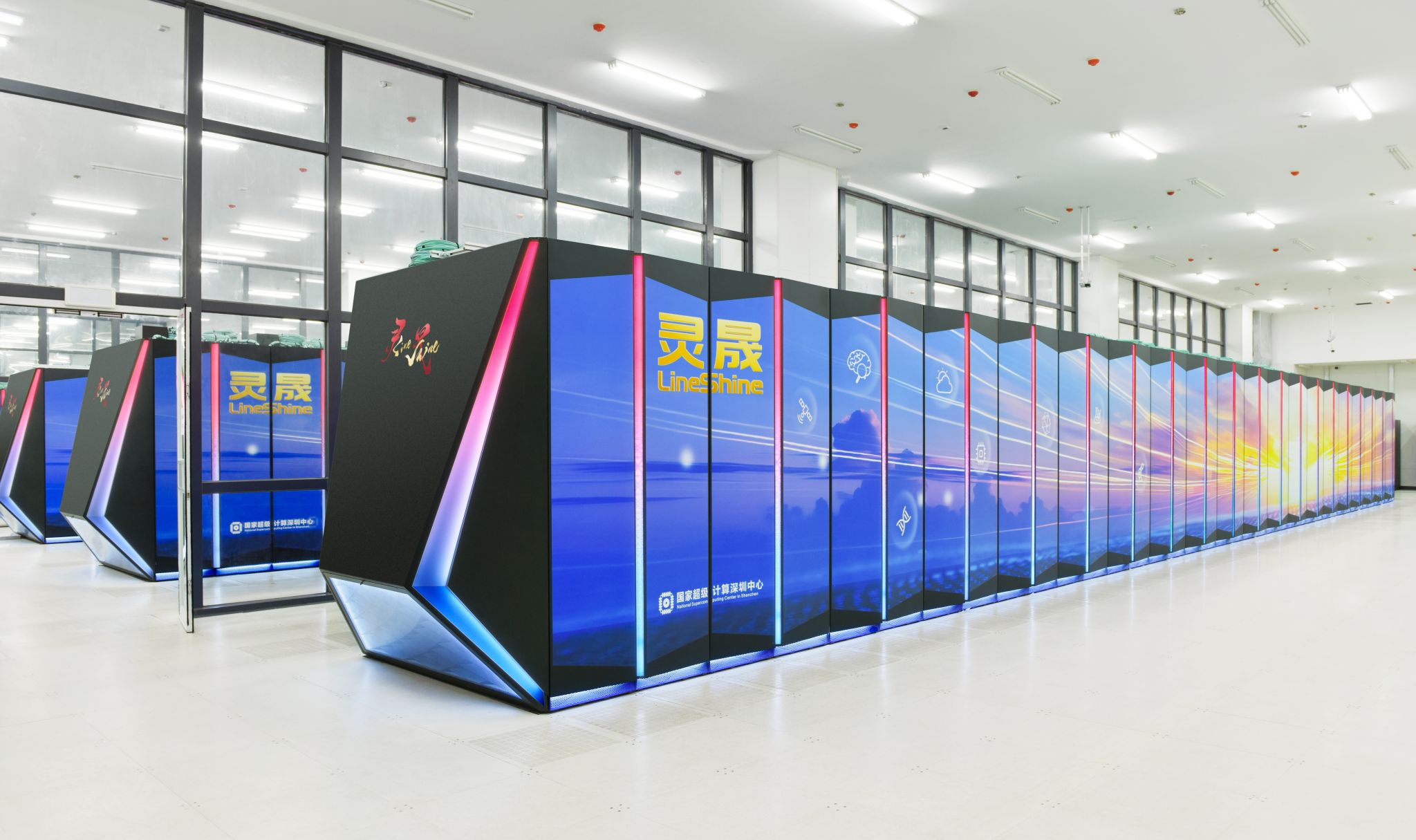
The LineShine supercomputer system is deployed at the National Supercomputing Center in Shenzhen.
In terms of infrastructure for scientific and engineering intelligent computing, LineShine has already supported applications in fields including atmospheric and ocean science, engineering simulation, materials science, drug discovery, brain science, scientific AI and large-model inference, according to Lei Kai, deputy director of the Shenzhen Computer Federation.
The TOP500 list, published twice a year, is widely regarded as a benchmark for global supercomputing performance.
Link to the reports:
Xinhua: https://english.news.cn/20260625/ab614ddd78614bf19235afd483aec723/c.html
South: https://south.newsgd.com/post/?k=44e22986fd




 COPYRIGHT©1999-2017 , SUN YAT-SEN UNIVERSITY