Wetlands are often called the "kidneys of the Earth," but to the researchers at Sun Yat-sen University (SYSU), they are a living laboratory of resilience and mystery.
To celebrate World Wetlands Day, we are shifting the lens from the laboratory to the mud. Based on the long-term field observations and frontline research materials provided by our faculty and students, we invite you to experience a "Get Ready With Me" (GRWM) vlog—from the unique perspective of a mangrove tree.
A Special Day with the Mangroves
Greetings, human.
I’m a mangrove.

A mangrove “selfie.” | Photo by Vice Prof. Pan Ying, School of Ecology
I grow where mornings smell faintly of salt,
where the ground never quite dries,
and the water never fully leaves.
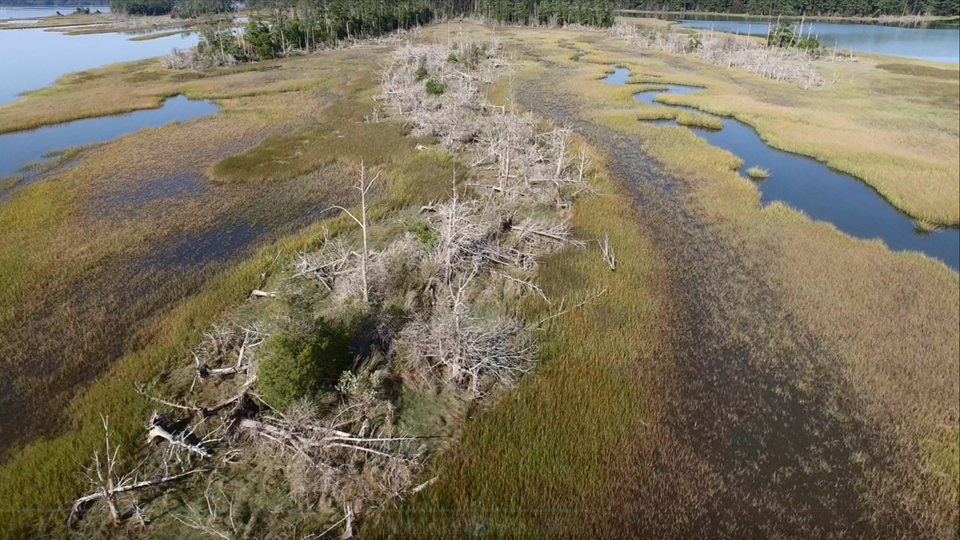
A salt marsh landscape. | Photo by Vice Prof. Chen Yaping, School of Ecology
This place doesn’t have clear edges.
—land fades into mud, and mud into water.
That in-between is where I belong.
That where you called wetlands.

A breathtaking view of the wetland ecosystem. | Photo by Vice Prof. Chen Yaping, School of Ecology
Today is World Wetlands Day.
So let me take you through my day—
nothing special, just how things usually go.
06:10 AM Before the Tide Comes In
My typical day starts in the early morning
while the sky is still dim.
The water is moving closer.
My roots sink deep into soft sediment—
not for beauty, but for survival.
This ground is unstable,
the waves are strong, and the salt is unforgiving.
If I fail to hold my place,
the coastline behind me moves backward.
So I must stay.

A salt marsh under the impact of sea-level rise. | Photo by Vice Prof. Chen Yaping, School of Ecology
08:30 AM Morning Visitors
As the tide rises, life follows.
Water moves back in,
quietly filling the spaces between roots.
Small bodies follow—
fish pass through, hide, leave again.
Moving among my roots,
using them as shelter.
While crabs await,
inside their little caves of mud.
Presence is timed carefully,
that’s how it works here.
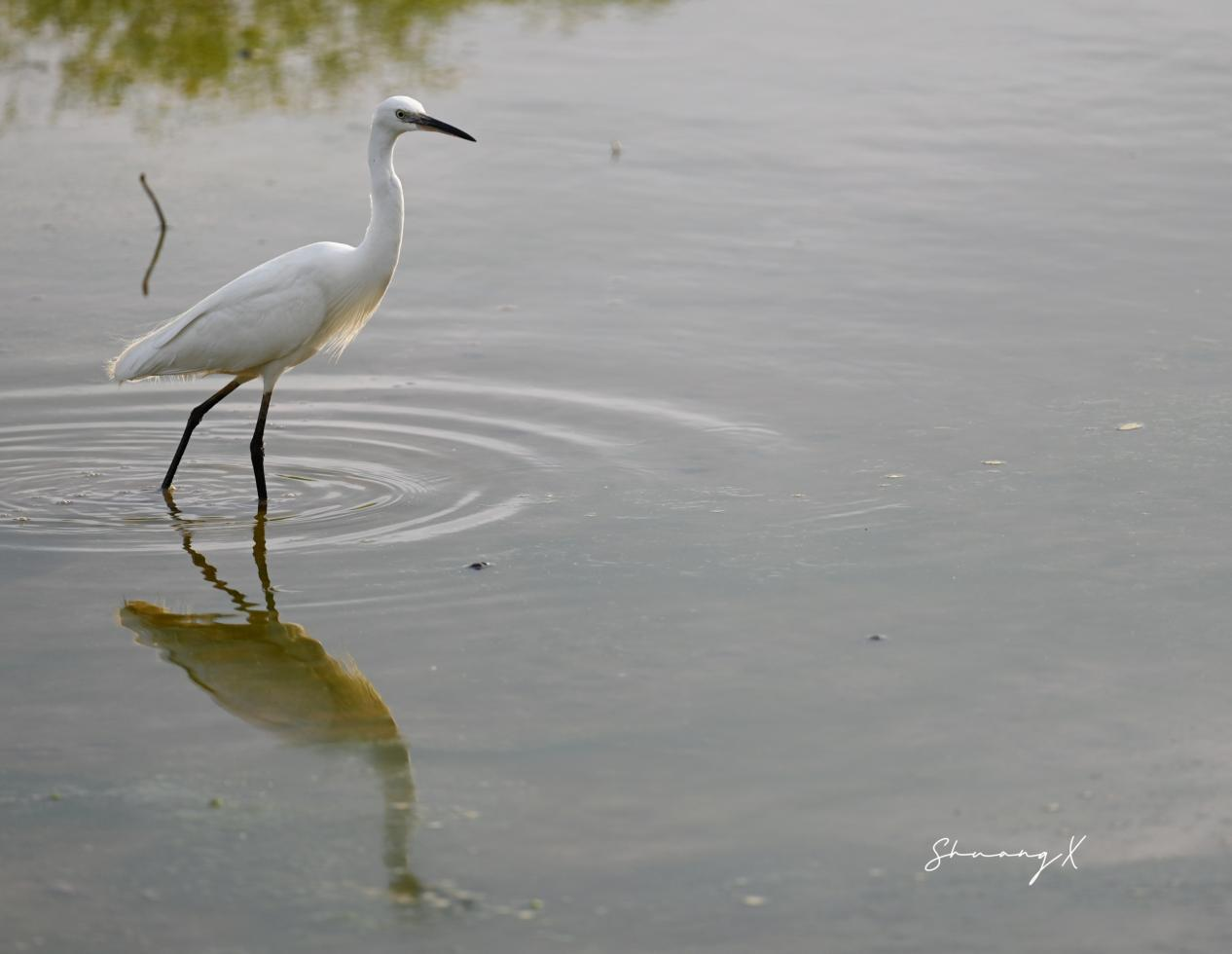
An egret spotted in the wetlands. | Photo by Vice Prof. Xing Shuang, School of Ecology
Sometimes, people arrive too.
They measure, observe, and record.
I’ve recognized them over the years:
they are researchers and students from SYSU.
This is not a one-day visit;
they have been coming back for years,
and I’ve learned their pace.

Roots of mangroves. | Photo by Vice Prof. Pan Ying, School of Ecology
Wetlands Notes
In some coastal regions, particularly Shenzhen, the rhythm of life is dictated by semi-diurnal tides—two high tides and two low tides every day. Consequently, the pulse of the wetland doesn't follow a simple day-night cycle. Many crabs are most active at low tide, emerging to forage on the exposed mudflats before sealing their burrows as the water returns. Meanwhile, fish glide into the sanctuary of mangrove roots with the rising tide, seeking temporary shelter. Different schedules, one shared sanctuary.
11:40 AM Under Pressure
The waves grow stronger,
and floating debris washes ashore.
Plastic often catches in my roots.
When storms come test my limits,
there is no applause when I absorb the impact.
But I do it anyway.
I break the waves, slow the erosion,
and stand as the shield between the sea and the land.

Great crested terns competing for food. | Photo provided by Prof. Liu Yang, School of Ecology (Photo by Zhou Danyang)
15:30 PM Low Tide
The water retreats,
exposing the dark, damp ground.
This is the quietest part of the day,
yet it’s when most data is collected.

A Terek sandpiper. | Photo provided by Prof. Liu Yang, School of Ecology (Photo by Zhou Danyang)
Tidal lines, salinity, vegetation—
the SYSU students are here,
not to control the wetland,
but to understand its rhythm.
They’ve learned that patience matters more than tools.

SYSU students conducting field research in the wetlands. | Photo provided by Vice Prof. Yang Yuchen, School of Ecology
18:50 PM Dusk
My day never actually ends,
It’s just one tidal cycle after another.
The wind cools, the heat softens..
Birds return to rest.

Black-winged stilts at dusk. | Photo by Vice Prof. Xing Shuang, School of Ecology
I don’t speak.
What was taken in during the day now settles—
in leaves, in mud, in quiet exchanges that don’t need watching.
I stand where I always do.
Between what comes and what stays.
I work constantly.
I filter water.
I store carbon.
I stabilize shorelines.
I provide habitat.
You may recognize these functions from textbooks.
For me, they are simply daily life.
Learning to Coexist
For years, experts and students across multiple disciplines at SYSU have called these wetlands their "second laboratory." Through seasons of field research and long-term monitoring, they seek not to conquer the wild, but to learn its rhythm. For them, true conservation is about understanding the delicate boundary where human interference ends and nature’s wisdom begins.


SYSU students conducting field research in the wetlands. | Photo provided by Vice Prof. Yang Yuchen, School of Ecology
On World Wetlands Day, we often talk about “protecting wetlands” as if we are outsiders lending a helping hand. But true conservation isn't about saving nature; it’s about relearning our place within it.
The tide will return tonight. I will still be here, breathing with the sea, holding the soil, and waiting for the dawn.
If today makes you want to step closer to a wetland, to slow down and look a little longer at the mud beneath your feet, then my story has already mattered.
Source: SYSU Global Communication Office, School of Ecology
Special Thanks: Professor Liu Yang, Vice Professors Yang Yuchen, Chen Yaping, Pan Ying, Wang Fan, Xing Shuang from the School of Ecology for their scientific support and photographic contributions
Writer: Zhang Dingwen
Designer: Zhang Dingwen
Editor: Feng Xianzhe
Reviewer: Huang Yan, Chen Rongrong