A research team from the School of Ecology at Sun Yat-sen University (SYSU) has provided a pioneering explanation for the global distribution of tree diversity, revealing how complex "social networks" among trees sustain life in the world’s most diverse forests.
The study, led by Professor Chengjin Chu and published online in Nature on April 29, marks the first global-scale verification that "higher-order interactions" (HOIs) are a universal force shaping forest communities. The discovery offers critical new insights into the "Latitudinal Diversity Gradient"—a 200-year-old ecological pattern describing why species richness peaks at the equator and declines toward the poles.
Moving beyond traditional theories that focused solely on one-on-one competition between neighbors, the team suggests that a tree’s survival is actually dictated by its entire neighborhood. These complex group dynamics act as a natural "anti-monopoly" mechanism, suppressing the dominance of common species while providing a crucial survival advantage to rarer ones.
The researchers found that this stabilizing effect is most potent near the equator and weakens progressively toward the poles. This mechanism directly explains why tropical rainforests can support hundreds of species per hectare while temperate forests remain significantly less diverse.
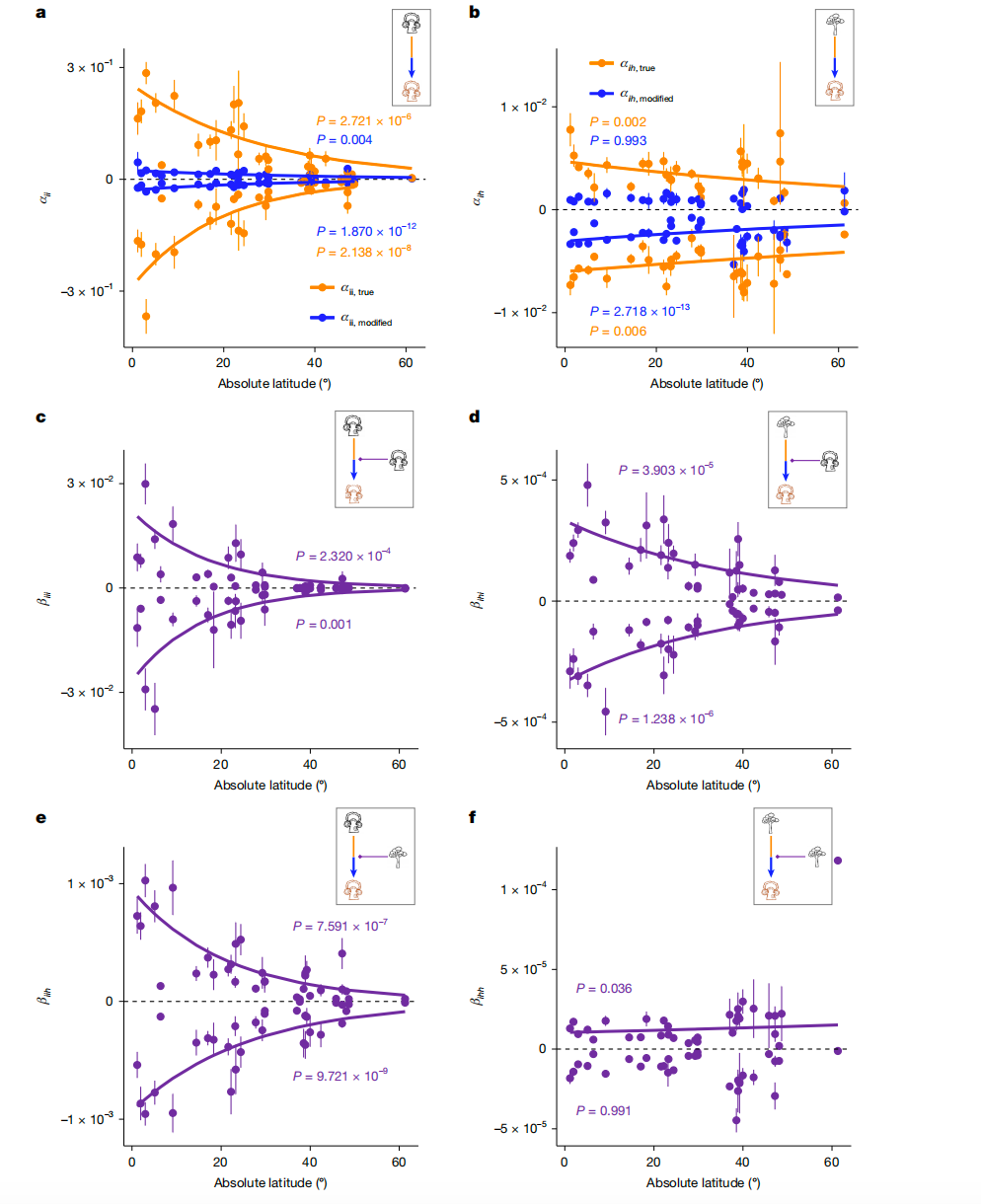
Latitudinal changes in pairwise and HOIs for growth models.
These landmark findings are the result of an exhaustive eight-year research project. The team synthesized data from 32 major forest monitoring plots across six continents, analyzing over 3 million individual trees and more than 5,000 species. Their analysis confirmed that higher-order interactions significantly influence approximately 40 percent of the species studied, proving they are a fundamental pillar of forest ecology.
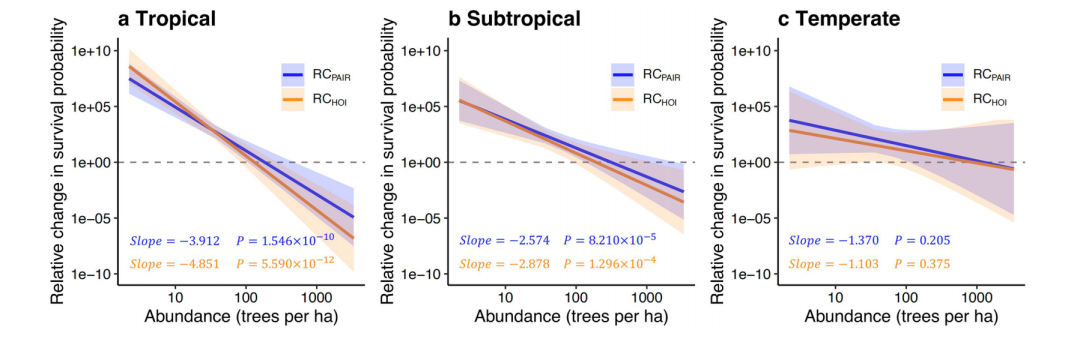
Predicted relationships between relative change in survival probability and species abundance across three latitudinal geographic zones.
Beyond its theoretical contributions, the study offers a transformative perspective for global environmental conservation. The researchers emphasize that successful forest restoration must move beyond simply planting individual trees. Instead, it must prioritize rebuilding these hidden "biological stabilizers"—the intricate interaction networks that make ecosystems resilient to climate change and biodiversity loss.
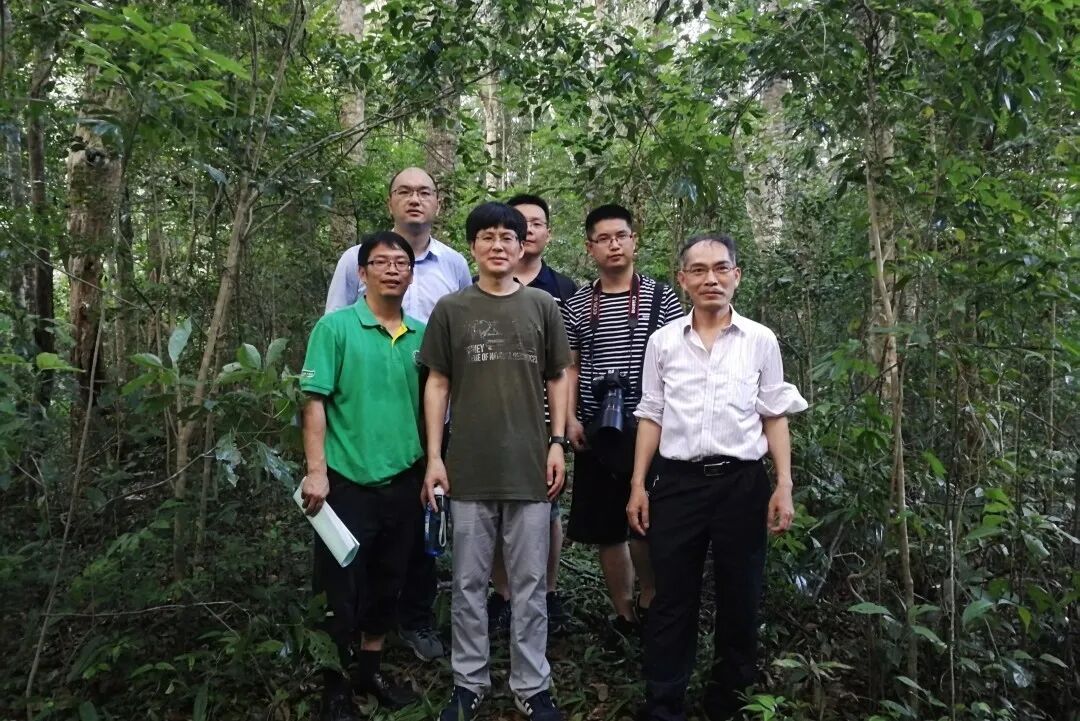
Professor Chengjin Chu (center), Vice Professor Yuanzhi Li (second from right), and members of the research team from the School of Ecology.
This achievement underscores Sun Yat-sen University’s leading role in addressing fundamental questions about the natural world, providing a new scientific framework for preserving the planet’s vital ecological heritage.