Recently, a team led by Associate Professor Zhang Dongjing of the Zhongshan School of Medicine at Sun Yat-sen University (SYSU), in collaboration with Dr. Jeremy Bouyer, Research Director in Ecology and Control of Vectors at the French Agricultural Research Centre for International Development (CIRAD), conducted a field trial in Guangzhou, China, using a robot dog to release sterile male mosquitoes. The trial marked the first integrated test of a robot-dog-based release platform and explored an automated approach to the Sterile Insect Technique (SIT). It was supported by the Foreign Experts Program.
The trial builds on a longstanding research partnership between Dr. Zhang and Dr. Bouyer in developing SIT for mosquito control. The two researchers have co-authored papers in high-impact academic journals, including Nature Communications and Trends in Parasitology. In 2025, with funding from the Foreign Experts Program, project leader Dr. Zhang invited Dr. Bouyer to Guangzhou to collaborate on research, substantially advancing bilateral technical exchange, the optimization of trial protocols, and joint analysis of field data. Building on this foundation, CIRAD and SYSU have continued to strengthen their collaboration mechanisms and recently signed a bilateral Memorandum of Understanding (MOU), establishing a long-term, stable, and regular framework for cooperation and laying the institutional groundwork for future joint trials, technology sharing, and researcher exchanges.

Dr. Bouyer Invited to Advise Graduate Students on Their Research (December 2025)
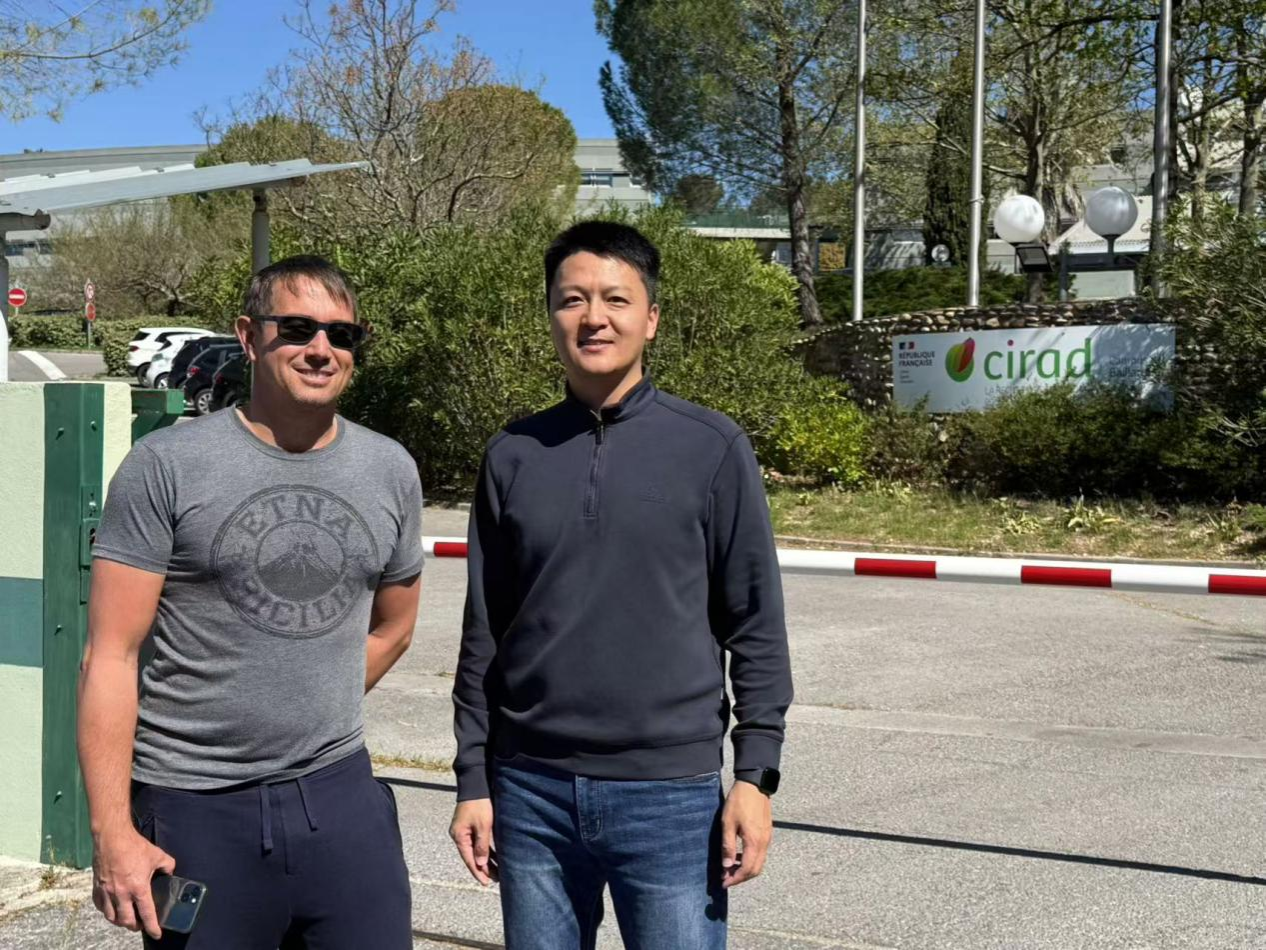
Dr. Zhang Invited for a Research Visit to CIRAD (April 2026)
During his visit to Guangzhou, Dr. Bouyer focused on reviewing field mosquito release trial data with Dr. Zhang’s team, summarizing the outcomes of SIT implementation in the field, analyzing the remaining challenges, and jointly discussing optimization strategies for the next phase of trials. In parallel with the workshops, the three parties jointly conducted an innovative test to release sterile male mosquitoes using a robot dog. The CIRAD team provided a dedicated mosquito release device developed in collaboration with the companies Cicindela (Spain) and MoSITouch (France); the collaborating company Firedog (Shenzhen, China) supplied the mobile robot platform; and SYSU was responsible for providing the standard-reared sterile male mosquitoes and field trial sites. Leveraging the respective technological strengths of each party, the three partners integrated the entire process, from the release device and mobile platform to mosquito supply and field release, and completed the first integrated release.

Sterile Male Mosquito Release Trial Using Robot Dog (October 2026)
Conventional manual release of sterile male mosquitoes has notable shortcomings, including high labor costs, limited accessibility in complex terrain, and difficulty in ensuring uniform distribution. This robot dog release test aims to harness the terrain-navigation capability of mobile robots to substitute part of the manual workload, improving the release efficiency and spatial uniformity of sterile male mosquitoes, reducing on-site labor input, and expanding the application potential of SIT across diverse scenarios such as residential communities, green spaces, and complex urban environments. Male mosquitoes do not bite humans or feed on blood. When released in the field, they mate with wild females and cause the resulting eggs to fail to hatch normally, thereby sustainably suppressing Aedes mosquito population densities, a green and safe approach to mosquito-borne disease control.
Dr. Zhang stated that this robot dog release test represents an important exploration of the equipment-based and intelligent application of SIT, and a landmark step in the collaboration between SYSU and CIRAD, advancing from basic and applied research and field trials toward equipment innovation. He expressed sincere gratitude to the Foreign Experts Program for its funding support (H20250836), noting that the Program has created valuable conditions for face-to-face exchanges between Chinese and international experts and for joint frontier trials. In the next phase, the collaborating parties will continue to optimize the stability and release parameters of the robot dog release system, conduct multiple rounds of repeat testing, and steadily refine this novel release approach. Meanwhile, building on the signed MOU, they will continue to deepen the international collaboration between SYSU and CIRAD in mosquito-borne disease control, sharing trial data and jointly developing new technologies, and collectively contributing to the development of a global green technology system for the control of mosquito-borne infectious diseases such as dengue and chikungunya.
The automated release machine is developed and tested with the support of the Reunion Region «Aide aux fonds propres des jeunes entreprises innovantes » (AUTOMOUS project) to MoSITouch and the grants No 101086257 (INOVEC Project) from the European Union, and OpTIS project, co-financed through the FEDER program by the European Union and the Réunion Region, to CIRAD.